ChatGPT Ads for SaaS Founders: A Repeatable Critique-and-Rewrite Playbook
ChatGPT ads work best as a critique and rewrite loop. Learn the playbook, then hire your AI marketing agent and get Infinite.
On this page
- Why Most ChatGPT Ads Fail on the First Prompt
- Step 1: Collect the Inputs Before You Ask AI to Write Anything
- Step 2: Build a Founder Brief That Produces Specific Copy
- Step 3: Run the Critique-and-Rewrite Loop for ChatGPT Ads
- Step 4: Turn the Output Into Testable Social Ad Variants
- Step 5: Feed Performance Back Into the Prompt, Not Just the Dashboard
- Where Infinite Fits if You Want the Loop to Run Continuously
- Frequently Asked Questions
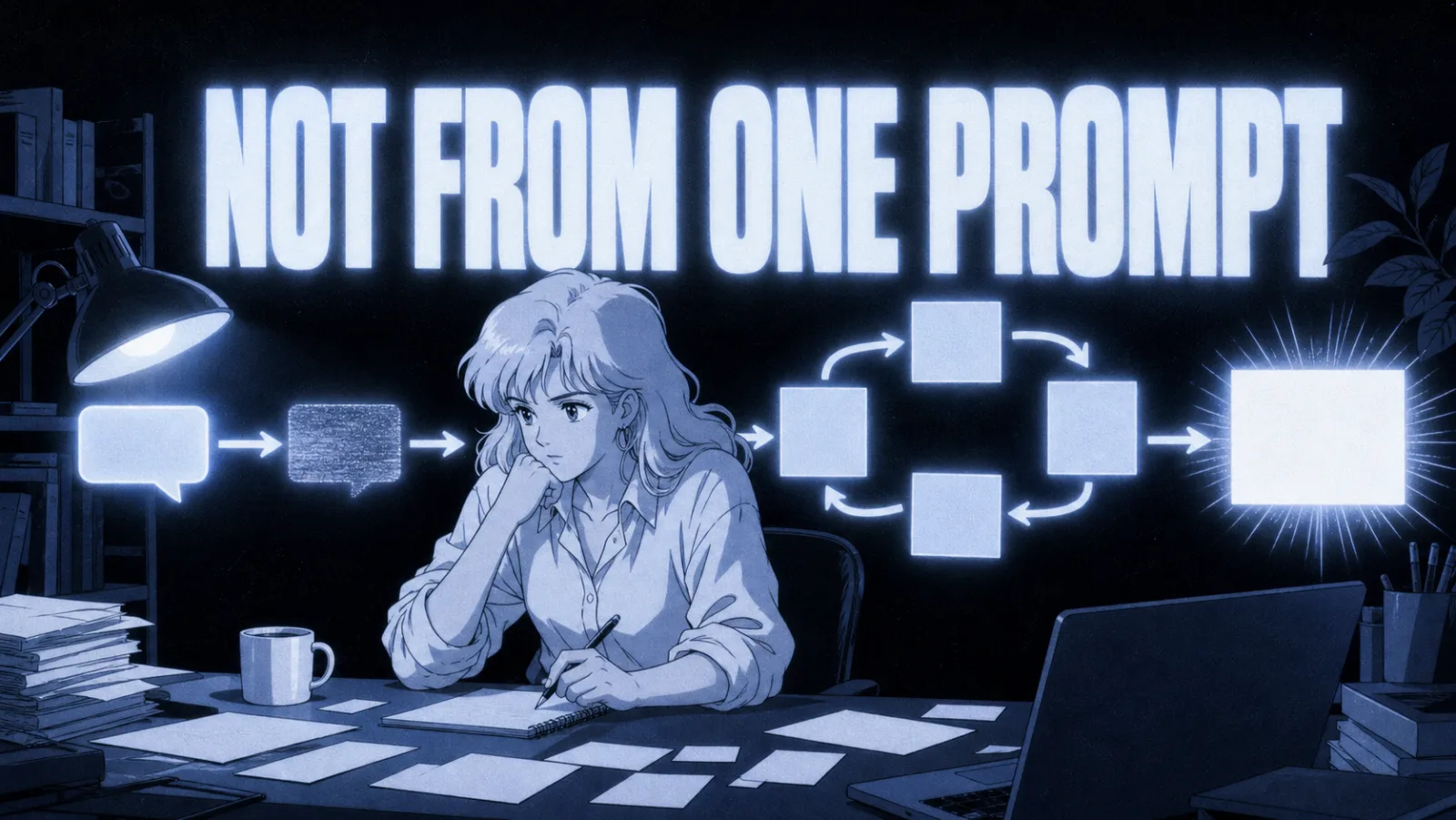
ChatGPT ads can help SaaS founders produce sharper social creative, but not from a single prompt. The reliable workflow is to feed the model real offer context, critique the first draft against proof and objections, then rewrite around a testable hypothesis before anything goes live.
Why Most ChatGPT Ads Fail on the First Prompt
Most founders start with the wrong request: “write me 10 ads for my product.” That usually produces smooth, generic copy because the model has none of the details that make an ad believable, the offer, the stakes, the proof, the objections, or the action the click is supposed to drive.
OpenAI’s prompt engineering best practices for ChatGPT make the core point clearly: prompting works best as an iterative process where the user reviews output and refines the prompt. The OpenAI Academy writing guide, published April 10, 2026, frames the workflow as plan, draft, revise, package, and tells users to verify claims involving numbers, policies, or specifics.
That matters because a solo founder does not need more raw output. The useful operating model is tighter than that: bring in founder knowledge, generate a first draft, critique it against buying triggers, then rewrite with a clearer hypothesis. HubSpot Marketing makes a similar case in How to Run ChatGPT Ads: The Complete Tutorial, arguing that message relevance comes from matching the buyer’s live question, not blasting a broad interruption ad. The edge is a faster loop between positioning, account signals, and revision, well past more copy.
Step 1: Collect the Inputs Before You Ask AI to Write Anything
Before ChatGPT writes a line, the founder needs source notes that describe a real buying situation. The minimum set is straightforward: ideal customer profile, category, painful job-to-be-done, offer, pricing model, strongest proof, competitor alternatives, common objections, and the exact action the click should drive.
The receipt is practical. Pull those inputs from the landing page, demo call notes, onboarding answers, support tickets, churn notes, and comments on both failed and winning ads. OpenAI’s developer prompt engineering guide recommends supplying relevant context, explicit constraints, examples, and structured formats. Real customer language does that better than a blank document.
What inputs make an ad prompt less generic?
Useful inputs describe a buyer in motion, not a product category. “Analytics tool for startups” is too loose. “Privacy-conscious B2B SaaS founders who need weekly attribution reports without hiring an agency” gives the model a buyer, a pain, and a reason to care.
The common failure is “the product does a lot.” That can be true, but it weakens the prompt. The fix is forced prioritization: one buyer, one problem, one promised outcome per prompt cycle. If a founder cannot narrow it to that level, the ad is not ready to be written.
Step 2: Build a Founder Brief That Produces Specific Copy
Raw knowledge needs structure before it turns into useful copy. A working founder brief should include the problem, why it matters now, the current workaround, differentiators, proof points, constraints, banned claims, tone, format, and destination. As of April 10, 2026, the OpenAI Academy writing guide explicitly recommends clarifying the goal, audience, raw material, constraints, and revision criteria before expecting strong output.
Specificity beats cleverness because buyers do not buy abstractions. They respond to language that sounds like their own internal monologue. The strongest prompts include phrases lifted from real conversations, especially how buyers describe wasted time, confusion, switching friction, or the fear of choosing the wrong tool.
A simple contrast makes the difference obvious:
| Input quality | Founder brief example | Likely output | When to use it |
|---|---|---|---|
| Too vague | “AI tool for marketers” | Generic productivity copy | Never, it lacks a buyer and a wedge |
| Better | “SaaS for founders who need ad ideas fast” | Decent hooks, weak proof | Early brainstorming only |
| Strong | “Bootstrapped SaaS founder rewriting Meta ads, wants clearer hooks tied to trial signups” | Specific pain-first copy | First real draft |
| Strongest | Same brief, plus objections, proof, banned claims, and comments from failed ads | Sharper angles and cleaner rewrites | Production workflow |
A worked pair helps here. Bad input: “growth tool for SaaS.” Good input: “indie SaaS founders juggling spreadsheets, ChatGPT, and disconnected feedback, now stuck rewriting Meta ads without a clear path from click to trial.” The second version gives the model a user, a frustration, and a business action.
Step 3: Run the Critique-and-Rewrite Loop for ChatGPT Ads
The repeatable process has five moves: draft, critique, rewrite, compress, and variation-test. As of August 8, 2026, OpenAI’s Help Center guidance and developer prompt guide both treat output as something to review and refine, not as a finished marketing asset.
The critique stage is where most founders cut corners. Instead of asking for “10 better versions,” ask for a scored review across clarity, relevance, specificity, proof, objection handling, and distinctiveness. Then ask four direct questions: what sounds interchangeable, where the promise is too broad, what claims lack evidence, and where the copy ignores the real wedge against alternatives such as Jasper, Tofu, or Relevance AI.
How should the critique be judged?
A critique is only useful if it changes the decision, not just the wording. After each pass, the output should be one cleaner angle and one concrete test hypothesis.
| Stage | What to produce | Failure mode | What it means for the founder |
|---|---|---|---|
| Draft | One clear angle | Sounds like any SaaS ad | Stop and sharpen the buyer or problem |
| Critique | Specific weaknesses by category | Feedback like “make it punchier” | Re-run with scoring criteria |
| Rewrite | One stronger version | Same message in new words | Reject it as duplication |
| Compress | Shorter hook and body | Loses proof or audience fit | Keep it only if the claim still holds |
| Variation-test | Distinct angles | Synonyms dressed up as options | Launch fewer, cleaner tests |
The stop condition matters. Test when each variant represents a different hypothesis. If the same objection keeps returning, the problem is the offer, proof, or landing-page continuity rather than the prompt.
Step 4: Turn the Output Into Testable Social Ad Variants
Once the copy is sharper, it has to become a real test. That means one angle per ad set, one hook family per test, and one success metric tied to the selected objective.
Meta’s Traffic objective documentation says traffic campaigns are built to send people to a destination such as a website or landing page, and should give way to lead, messaging, or sales objectives when those are the actual goals. Meta’s Awareness objective documentation says awareness is about reach, recall, impressions, and video-view behavior, not direct purchase intent. The practical implication is simple: judge the ad on the action the platform was actually told to optimize for.
The creative type should match buyer intent. A pain-first ad fits prospects who already feel the problem. A proof-first ad fits skeptical evaluators. A comparison ad helps buyers weighing options. A founder-led ad works when operator credibility is part of the offer. Mixing all four into one crowded variation slows learning.
For lean teams, the challenge is overproduction. Thirty AI variants can feel productive while teaching almost nothing. The fix is fewer variables and tighter hypotheses. Three distinct tests usually beat a pile of near-duplicates because the result points to the next move. For founders working through that execution problem, Infinite’s guide to Facebook Ad Automation Without Killing Performance is a useful next read.
Step 5: Feed Performance Back Into the Prompt, Not Just the Dashboard
The loop only improves when campaign feedback returns to the next rewrite. Useful inputs include click-through rate, cost per click, comment quality, repeated objections, and where users drop off on the landing page. Without that feedback, ChatGPT ads stay trapped at the draft stage.
HubSpot Marketing argues in How to Run ChatGPT Ads: The Complete Tutorial that founders should first test the real questions buyers ask and check whether the brand already appears in AI-generated consideration sets. That is a useful preflight step because weak positioning limits what paid creative can do.
A practical decision rule keeps the rewrite loop honest. Angles that win attention but fail to convert usually need stronger offer clarity, better proof, or tighter landing-page continuity. Angles that never win attention need a new hook or a different problem frame. Those are different failures, so they should not trigger the same rewrite.
This is the operating advantage. The model becomes more useful when it learns from account feedback and buyer reactions, not when the founder keeps asking for fresh copy in isolation.
Where Infinite Fits if You Want the Loop to Run Continuously
Disclosure: this guide is published by Infinite, which is our own product; it is judged here on the same criteria as every other tool named above.
A founder can run this workflow by hand: collect context, draft, critique, rewrite, launch, review results, and repeat. For occasional copy help, plain ChatGPT is often enough.
The bottleneck changes when the problem is no longer writing, but coordination. Founders who struggle to turn offer context and ad feedback into repeatable tests usually do not need a larger prompt library. They need the loop to keep running across creative, analysis, and execution. Infinite fits that handoff. It connects offer context, ad creative generation, Meta ad analysis, and campaign or ad changes inside founder-set budget guardrails. It also tracks AI visibility across buyer questions and shows where the brand is cited or missing on platforms including ChatGPT and Google AI Overview.
That makes it one option, not a universal answer. If the need is occasional rewriting, manual prompting can be enough. If the bottleneck is ongoing execution across the whole growth system, the next step is to Hire your AI marketing agent, get Infinite.
The takeaway is simple: ChatGPT ads work best as an editing loop inside a measurement system. Founders who build that loop ship cleaner tests and learn faster from every round.
Frequently Asked Questions
Are ChatGPT ads the same thing as ads that run inside ChatGPT?
No. In this article, ChatGPT ads means ads created with ChatGPT for channels like Meta and other paid social platforms. Ads shown inside ChatGPT are a separate format with their own placement, delivery, and measurement model, so founders should not treat them as the same thing.
How many prompt-rewrite loops should a founder run before testing an ad?
Run enough loops to produce distinct angles with clear hypotheses, then stop. If the critique can no longer find vague promises, missing proof, or duplicated ideas, the ad is ready to test. If the same objection keeps surfacing, the issue is probably the offer or landing page, not the copy.
What inputs make ChatGPT ad copy less generic for a SaaS product?
The strongest inputs are buyer-specific: ideal customer, painful job-to-be-done, current workaround, offer, proof, objections, constraints, and the exact action the click should drive. Real language from support tickets, demo calls, and ad comments usually beats polished internal messaging.
Can ChatGPT improve paid social performance without access to account data?
It can improve draft quality, but it cannot replace the learning loop. Without account feedback, the model can produce clearer copy and stronger hypotheses, yet it cannot show which angle earns attention, which one converts, or which objection keeps blocking the click.
When should a founder use a tool like Infinite instead of prompt templates alone?
Prompt templates are enough when the need is occasional copy help and manual testing still feels manageable. Infinite becomes more useful when the bottleneck is ongoing execution, especially when ad feedback, rewrites, Meta changes, and AI visibility checks need to stay connected instead of living in separate tabs.
The AI CMO for founders
Infinite is the AI marketing agent that runs your SEO, content, ads, and analytics end to end.