SEO Writer AI: What to Buy When Copy Quality Isn’t the Bottleneck
SEO writer AI is not just about better copy. Learn what to buy for intent, publishing, and AI search, then get the right system.
On this page
- What Is SEO Writer AI Actually Buying You?
- Why Copy Quality Alone Is the Wrong Buying Metric
- Which Jobs Still Matter After the Draft Is Written?
- How Should a Tool Handle Intent, Not Just Keywords?
- What Does "Ready to Publish" Need to Include?
- Can an AI Writing Tool Help You Win AI Search Too?
- Where Standalone Writers Break for Solo SaaS Founders
- When Should You Choose a Writer Versus an Agent-First Growth System?
- Frequently Asked Questions
- Continue this guide
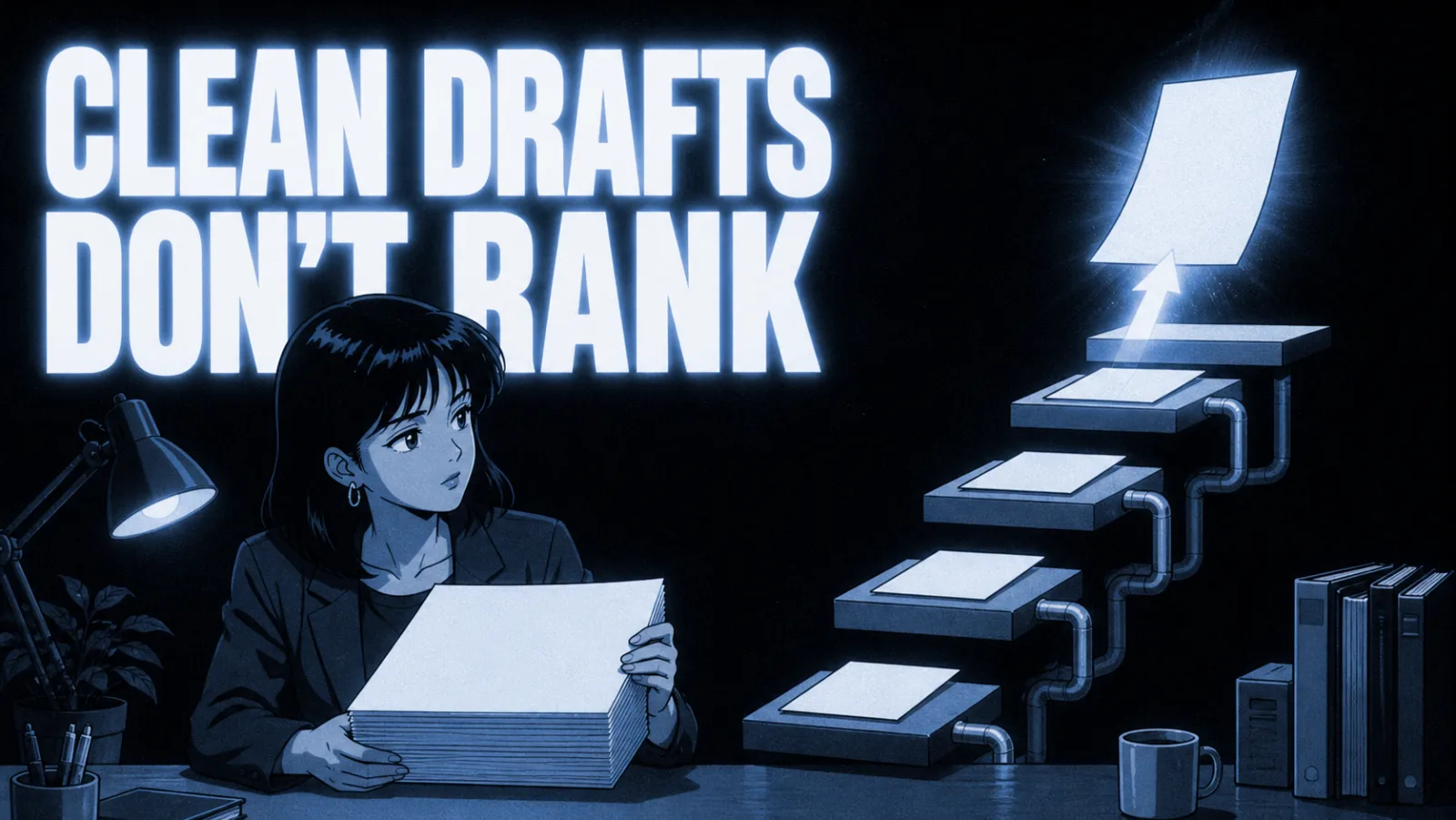
An SEO writer AI is worth buying only when it does more than produce cleaner drafts. For solo SaaS founders, the better choice is a system that turns a keyword into a page with the right intent, a clean publish path, and a way to learn after launch, because copy quality alone rarely decides whether content ranks or drives pipeline.
What Is SEO Writer AI Actually Buying You?
In plain English, most tools in this category sell speed. They help a founder go from blank page to draft faster, often with keyword prompts, outlines, and some level of optimization baked in. That matters, but it is not the whole job.
A founder usually is not buying words for their own sake. The real purchase is a workflow that takes a target keyword, chooses the right content format, gets the page live, and gives the founder enough feedback to decide what to do next. That means drafting speed belongs in the evaluation, but so do ranking potential, publish flow, internal-link planning, and post-publish measurement.
That distinction matters more for solo SaaS teams than for larger content operations. When one person owns research, writing, editing, publishing, and iteration, a writer that stops at text creation removes only the most visible bottleneck. The harder work still sits there: deciding whether the keyword deserves a comparison page, a help article, a commercial support post, or a broader cluster piece, then connecting that page to the rest of the site.
That is why the useful question is whether an SEO writer AI helps the founder produce an asset that can rank, support a buying journey, and keep improving after it goes live. Polish is the easy part.
Why Copy Quality Alone Is the Wrong Buying Metric
Readable copy is now baseline. Nearly every vendor promises human-sounding output, SEO optimization, and faster production, so surface quality stops being a serious buying filter very quickly.
The more important difference is execution quality. A draft can read smoothly and still fail because it targets the wrong query type, copies the wrong search-result pattern, skips key entities, ignores schema needs, or lands with no clear internal-link destination. In commercial search, those mistakes matter more than a clunky sentence or two.
That is the expensive founder mistake: publishing content that was aimed at the wrong job from the start. Mediocre prose can be edited. A bad content decision compounds because it wastes topic selection, review time, and distribution effort, then teaches the wrong lesson when performance disappoints.
This is also why "human-like" is such a weak promise. Commercial pages do not win because they merely sound natural. They win because they fit intent, reduce decision friction, and sit inside a site structure that gives the page somewhere useful to send the reader next.
For buyers comparing tools, the practical rule is simple: value the system that lowers decision errors, not just the one that produces prettier paragraphs.
Which Jobs Still Matter After the Draft Is Written?
Once the article exists, the operational work starts. Someone still has to validate search intent, map the page to a landing page, choose anchor targets, set metadata, publish cleanly, and measure whether impressions turn into clicks and signups.
Those jobs matter more in commercial search than in pure informational publishing. A SaaS company is not filling a calendar for its own sake. Each page should help a reader move toward a decision, whether that means learning a category, comparing vendors, or understanding a specific problem well enough to act. If the article has no defined role in that journey, good writing does not rescue it.
A common founder failure mode looks like this: the article is technically solid, maybe better written than competing posts, but no one decided what product page it should support, what CTA path it should feed, or how it fits a larger topic cluster. The result is content that looks finished and still has no job.
This is where many standalone writing tools feel complete while leaving the hardest value untouched. The visible output is the draft. The less visible work, page-role mapping and performance feedback, is what decides whether the draft helps growth or just adds to the archive.
For founders wearing every hat, the right software reduces that hidden work. The wrong software makes content production faster while leaving the strategic attachment points manual.
How Should a Tool Handle Intent, Not Just Keywords?
The real test is whether the tool can tell the difference between definitional, comparative, transactional, and action-oriented queries before it writes. If every keyword gets flattened into the same generic blog template, the tool is only producing text instead of helping with search strategy.
That matters for this topic because people searching for software in this category are rarely asking for a dictionary definition. They are evaluating options and trying to avoid buying a content toy that stops at the first draft. Ahrefs makes the same point in SEO in 2026: How I'd Rank in Google in the AI Era, arguing that action-driven queries still depend on pages that help users decide and click.
A useful system should shape the title angle, section structure, proof requirements, and page type from that intent. A comparison query needs tradeoffs and decision rules. A help query needs direct answers and extractable formatting. A commercial support article needs a clean relationship to the landing page it exists to reinforce.
So the buying question is whether the software classifies the search job before writing, well beyond inserting the keyword and generating sections. If it cannot do that, the founder is still responsible for the highest-value decision in the workflow.
What Does "Ready to Publish" Need to Include?
"Ready to publish" should mean more than finished copy in an editor. Buyers should check for CMS publishing, schema options, image handling, slug control, metadata support, and internal-link prompts that reflect the actual site structure.
Those are legitimate buying criteria in this market. Dan from Smart Tutorials highlights this in SEOWriting AI Tutorial - 2026 | SEO AI Writing Tool for Generating 1-Click Blog Posts, where the walkthrough spends real time on WordPress publishing and structured-data controls, not just generation. That is a useful signal because founders who publish often do need operational help, not another blank page with a chatbot on top.
Still, one-click publishing is not the same thing as content strategy. A tool can push posts into WordPress and still do nothing to decide why that page exists, what commercial page it should support, or how weak performance should change the next topic decision.
That leads to the sharper buying question: is the product a text generator with publishing hooks, or a system that understands where each page belongs and why it exists? For a small team, that difference usually matters more than extra knobs inside the editor.
Can an AI Writing Tool Help You Win AI Search Too?
Yes, but only if it is built for more than classic blue-link rankings. A page can still rank well and lose traffic if the search engine answers part of the question before the click. In Ahrefs' April 2026 research, discussed in its 2026 video, the top-ranking page lost about 35% of clicks when an AI Overview appeared. In the later rerun cited in that same video, Ahrefs said the loss was closer to 58%. Those figures are time-bound, not timeless, but they are enough to change the buying lens.
Founders should now ask whether the tool helps with answer extraction, entity clarity, citation-friendly structure, and visibility across more than one discovery surface. As of Ahrefs' 2026 analysis, assistant citation patterns were not uniform either: it reported that 86% of top cited sources were unique to each assistant, with different mixes across Google, ChatGPT, and Perplexity.
That means discovery is now multi-surface. Google, Reddit, YouTube, review sites, ChatGPT, and Perplexity all shape who gets mentioned. No software can honestly guarantee citation, and any vendor promising that should be treated carefully. But some products are better aligned to current AI-search conditions because they pair writing with visibility tracking and decisions about where the content should compete.
For solo founders, that is where Infinite is more useful than a pure draft tool. It can run strategy, writing, and publishing without the founder touching them, publish to the founder's own domain, and track visibility in Google AI Overview and ChatGPT so the content program is not blind after launch.
Where Standalone Writers Break for Solo SaaS Founders
Standalone writers usually break when article production gets faster than execution capacity. The founder can generate more posts, but cannot choose targets, review claims, publish thoughtfully, and learn from results at the same pace. Output rises, while the backlog does too.
That is the core tradeoff in this market. Jasper is a familiar choice when a team mainly wants a dedicated writing environment. Tofu, MindStudio, and Relevance AI come up when buyers want broader automation or agent behavior around marketing tasks. Specialist SEO writers can also be useful when the main gap is article throughput inside an existing process.
No single model wins for everyone. The pattern is that solo founders rarely suffer from a lack of text. They usually suffer from broken continuity between planning, drafting, publishing, and iteration. A workflow-first tool can improve one step. An agent-first system is more helpful when the founder needs the chain to keep moving after ideation.
So the right comparison asks which software keeps the program coherent when one person has to run the whole thing, well ahead of which software writes better.
When Should You Choose a Writer Versus an Agent-First Growth System?
Choose a standalone writer if the company already has strategy, editorial process, publishing discipline, and a habit of reviewing performance. In that setup, a focused writing tool can be the right fit because the rest of the machine already exists.
Choose an agent-first system when execution stalls after ideas are generated. That is the better fit when one founder is trying to manage SEO, AI-search visibility, landing pages, and feedback loops without a team behind them. In that case, continuity matters more than draft speed.
| Option | Best for | What it does well | Tradeoff you accept | When to pick it |
|---|---|---|---|---|
| Standalone AI writer | Teams with an existing content process | Fast drafting, editing, repurposing | Strategy and iteration stay manual | Pick this if content ops already run smoothly |
| Specialist SEO writer | Operators focused on article production | SEO-oriented briefs and article templates | Narrow scope beyond content production | Pick this if throughput is the main bottleneck |
| Workflow automation tool | Teams with repeatable marketing tasks | Connects systems and reduces admin work | Someone still has to steer content strategy | Pick this if the process is defined already |
| Agent-first growth system | Solo founders and lean SaaS teams | Connects planning, writing, publishing, and learning | More opinionated operating model | Pick this if execution keeps stalling after ideation |
Infinite belongs in the last category. It is one option for founders who need SEO, AEO, landing pages, and feedback loops handled together, especially when a flat monthly price matters more than usage-credit math. Dedicated writers can still win for established teams, but understaffed founders often need execution continuity more than another drafting interface.
The practical takeaway is simple: the right buying decision is less about which tool writes the smoothest paragraph and more about which system can carry a content program from keyword choice to published outcome. For founders who need that full chain, Hire your AI marketing agent - Get Infinite.
Frequently Asked Questions
Is an SEO writer AI enough to rank for competitive SaaS keywords?
No, not by itself. Competitive SaaS terms usually require strong intent match, the right page type, a clear role in the site structure, and ongoing iteration after publish, not just readable copy.
What should an SEO writing tool do besides generate copy?
It should help classify intent, shape the right content format, support metadata and schema, publish cleanly, and connect the article to the page it is meant to support. The stronger tools also help measure whether visibility turns into qualified traffic.
Can AI-written articles still win clicks when AI Overviews appear?
Yes, but the page has to earn the click with clearer decision value and better formatting for extraction. AI Overviews compress some informational traffic, so commercial content needs sharper positioning and stronger support from the rest of the site.
How should solo founders compare flat-rate tools against usage-credit writers?
The practical test is operational predictability versus narrower drafting power. Flat-rate products suit founders who want steady execution without watching consumption, while usage-credit tools can work for teams that only need bursts of article generation.
When is an agent-first platform a better fit than a standalone AI writer?
It is a better fit when the founder can get ideas and drafts, but still struggles to turn them into a reliable growth system. If the bottleneck is everything after ideation, an agent-first platform is usually more useful than another writing interface.
Continue this guide
The AI CMO for founders
Infinite is the AI marketing agent that runs your SEO, content, ads, and analytics end to end.